
The 100 treasures of Univ
 The first Treasure was published on the Univ website in August 2013: appropriately it was the first College statutes of 1280/81. The idea of the Treasures project was and remains to highlight objects that reveal, often in unexpected ways, something of the history and life of Univ—its buildings, its collections, its people. Most but but not all of the Treasures have been from the College Library or Archive. For the occasion of the 100th Treasure, just over a decade since the publication of the first, the College Librarian and Archivist asked a number of staff members, emeritus and honorary Fellows, and Old Members to choose their favourite Treasure and comment on it. Ranging across most of the 775 years of Univ’s existence, from the early fourteenth century (a medieval bestiary chosen by Christine Ritchie) to 2014 (the year of the Clintons’ visit to the College after Chelsea’s DPhil graduation), the selected Treasures illustrate something beyond the College itself: the various religious, political, cultural, artistic, and social contexts in which its history has unfolded. Most are physical objects, but a few are events or persons. Taken together, however, they suggest powerfully that the College has existed never in isolation but always in relation to external conditions and developments, some profoundly disruptive.
 The Book of Hours chosen by Helen Cooper reminds us of Univ’s foundation as a medieval religious institution, the Mercator atlas chosen by Thomas Connelley of its connection to early modern advances in knowledge. And together these two objects represent the momentous transition from a manuscript to a print culture. The photo album chosen by Robin Darwall-Smith is a valuable record of student life immediately before—and to be permanently changed by—the First World War. The SCR menus chosen by Keith Dorrington and staff Christmas party records chosen by Liz Fleetwood reveal aspects of Oxford social life and culinary tastes in the 1930s and 1940s. Bill Clinton’s visit in 1994, mentioned by both Christopher Pelling and Sir Ivor Crewe, exemplifies the College’s connections with contemporary politics, while the Civil War pamphlet chosen by Andrew Bell reminds us of Oxford’s central role in that conflict. The Treasure chosen by Sandy Nairne, the model of the rejected design for Main Quad, is a remarkable piece of British architectural history, attesting to Oxford’s conservative resistance to classical architecture. Without John Radcliffe, mentioned by Alastair Lack, there would have been no second quad, which in the event was required to be built in stylistic conformity to the first one. Arthur Stanley’s annotated classics texts, chosen by Colton Valentine, provide unusual insight into nineteenth-century pedagogical methods. And Elizabeth Adam’s choice, the Robert Ross Memorial Collection, given to Univ in 1932 after having been declined by Magdalen College, attests not only to the troubled process of Oscar Wilde’s literary canonisation, but to changing social and sexual mores in the twentieth century.
Nicholas Halmi (Fellow Librarian) — January, 2024
Inside a Victorian lecture room
 Selected by Colton Valentine (Yale, PhD candidate in English)
Professors are often remembered for the books they wrote rather than the ones they taught, and Arthur Stanley is no exception. A titan of ecclesiastical history and voice of liberal theology, Stanley’s collected works comprise 32 volumes—which doesn’t count the notes he took while secretary of the landmark 1850 Royal Commission on university reform. But as this Treasure attests, Stanley was also a devoted teacher of the classics. His copies of Herodotus, Cicero, and Aristotle give us rare insight into not only what but also how he tutored at Univ—often making use of a colour-code scheme that distinguished matters of linguistic, historic, and philosophic interest. I have never been a chromatically inclined annotator, but my marked-up books are indispensable to my teaching. Each time I (re)read, I make lists of key passages grouped by theme on the volume’s title page: these serve as the foundation for lecture notes and help me locate passages quickly in response to a given student query. Lines of particular wit or insight receive a different treatment: I commonplace these in an orbit around the passage list or else in the book’s back pages. Though I teach material that Stanley would never have assigned—namely the vernacular works published during his life—our aide-memoire approaches aren’t all that dissimilar. Little did he know we’d soon be marking ‘truths for all time’ in George Eliot alongside Aristotle!
Published April 2023, read the full Treasure .
Sir Ernst Chain: Penicillin pioneer
 Selected by Dr Keith Dorrington (Emeritus Fellow)
Your invitation to me to choose a favourite ‘Treasure’ from one hundred has been an honour that has sent me into corners of Univ history which have been a delight to discover. At first, I wanted to go for and the story of the University stealing so much of the 1249 bequest of William of Durham “for itself and for certain magnates of the realm” that only enough could be scraped together by the executors of the will some thirty years later to support 4 of the intended 10-12 scholars who were to become the first Fellows of Univ. This history of ‘excessive overheads’ taken by a university from funds intended for ‘innovations in teaching’ is a reminder that enrichment of the wealthy at the expense of those less well provided for is always with us and we should continue to be vigilant against corruption.
But my real front runner has to be Univ’s lost opportunity to acquire a Nobel laureate: Sir Ernst Chain: Penicillin Pioneer. The ‘Treasure’ tells us that Chain was a Jewish refugee from Nazi Germany and involved in the development of penicillin in Oxford in the early 1940s. A letter to Master Wild on May 1st, 1943, recounts that Chain was a member of the Senior Common Room and “it is natural for me to wish to become a member of 182t¸£Àû”. We see in the ‘Treasure’ that in the same month he enjoyed High-Table asparagus, York ham, and ice pudding with chocolate sauce, so we note that even in times of hardship the College was able to serve a three-course meal for members of the Common Room. And what distinguished company to have at the small gathering that evening! Chain did not become a member of the College. In 1945 he was jointly awarded the Nobel Prize in Physiology or Medicine with Howard Florey and Alexander Fleming. It would have been interesting to be a fly on the wall if Master Wild took Chain’s request for membership of the College to the Governing Body, to hear what might have been said for and against his request.
Published January 2021, read the full Treasure .
Less study and more exercise
 Selected by Alastair Lack (History, 1964)
The Univ Treasures are indeed a treasure house of manuscripts, architecture, interests, and fashions over the centuries.
Having always admired , here was a description of why he was so respected and admired; it was fascinating to know more about at Univ and even … and perhaps best of all, . Here’s , the first black African to take a degree at Oxford, as well as , a German and Univ undergraduate who died in World War One. And let’s not forget .
But in the end, I have chosen as my Univ ‘Treasure’, an article on John Radcliffe.
We all know his name reverberates round Oxford. But who was he? We discover a blunt speaking medical man with clients in Oxford and London: Isaac Newton, Jonathan Swift, Alexander Pope. A doctor of diagnostic skills and sensible treatment – his advice for Alexander Pope was ‘less study and more exercise’. A man who mixed with royalty and yet befriended . And a doctor who remembered his old college, Univ, as a generous donor in and after his lifetime.
Published June 2023, read the full Treasure .
Bill Clinton’s Honorary doctorate, 1994
 Selected by Professor Chris Pelling (Emeritus Fellow)
I remember the day, and the events leading up to the day, very well. There was great excitement beforehand, with US security men thronging the college for a week or more; any attempt to blend in was rather hampered by their wearing sharp suits, not the usual mode of dress in an Oxford college then or now, and their response to any cheery greeting with a smart ‘Good morning, SAHR’. Nervousness may have been increased by the timing of an Inspector Morse episode a week or so earlier, centring on an assassination attempt at an Encaenia and thoughtfully identifying the room in the Bodleian most conveniently placed for a clear shot. There was a good deal of milling around in the Radcliffe Quad on the day, I remember, though it was rather delayed because the President lingered for much longer than scheduled going over old times with his crony, Head Porter Douglas Millin. There had been a lot of discussion in Governing Body on the question whether the President should be given any memento of the occasion; some intricate balancing resulted in a decision that this was inappropriate – he had already received an Honorary Fellowship, and what more could one ask? – but that it would be utterly suitable to make a presentation to Mrs Clinton, not merely as First Lady but as the US Secretary for Health. One of the expectations of the Classics Fellow (not, I think, ever mentioned in the job specification) is the ability to come up with Latin quips suitable for inscription on silver. I wish I could remember the Latin that emerged from agonised musings in my night-time bath, but it was something along the lines of ‘a health from 182t¸£Àû to the promoter of universal health’. It was very Oxford to think that a claret jug of generous capacity should be a suitable gift to a country’s leading health professional.
A few years earlier the college had made that decision to award Bill Clinton an Honorary Fellowship; it was before he was actually President, though he was already the Democrats’ candidate and looked likely to succeed. His campaign asked that the fellowship should not be publicised until after the election itself; conceivably an endorsement from fuddy-duddy old Britain was thought unlikely to cut much ice with potential swing voters. On the morning after the American election Univ proudly flew the American flag. The Master, John Albery, had to be dissuaded from flying the Univ flag on top and the stars and stripes underneath, as in the days when pirates flew their skull and crossbones over the pennant of whatever ship they had captured. The Master’s sense of humour was individual and irrepressible, but even he was persuaded that this might not everywhere go down well.
They were very good days.
Published October 2021, read the full Treasure .
MS 120: Bestiary
 Selected by Christine Ritchie (former College Librarian)
When I was asked recently to select my favourite Univ Treasure, I binge-read all of the excellent articles in the Treasures series. At first, I was tempted to choose one which described features of the , which I had seen probably every day of my working life at Univ. Then I came upon the article about Manuscript 120, the fourteenth-century Bestiary, or Book of Beasts, and my mind was made up. Many sumptuous examples of bestiaries survive in the Bodleian, British Library and, notably, Aberdeen University Library, but, to my mind, the charm of Univ’s lies in its simplicity. Its illustrations lack costly gold leaf and lapis lazuli, but are full of life and, despite their serious allegorical intentions, great fun. I saw the manuscript ‘in the flesh’ only once or twice (it’s kept in the Bodleian), but I vividly remember a picture of giant bees emerging from a multi-coloured hive, hedgehogs rolling around a vineyard collecting grapes on their prickles, and a startling image of a Bonnacon. It was a creature with an extremely unpleasant habit when threatened (Google it).
Published October 2016, read the full Treasure .
Books of Hours: women’s literacy and religious lives
Selected by Professor Helen Cooper (Honorary Fellow)
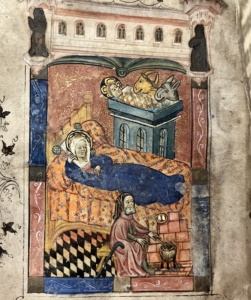
Univ library’s MS 5 is a Book of Hours, an example of the most personal of the various service books used within the medieval church. They might be owned by individual monks or nuns, or very often, and most famously, as the one religious volume within a household. The central text of such books is the liturgical Hours of the Virgin (‘hours’ referring to the timetable of services kept by monastic houses, and encouraged for use in pious lay households), supplemented by a calendar of saints’ days and an assortment of psalms and prayers. They were produced in especially large numbers on the continent and frequently imported into England; and they were usually illustrated, sometimes very finely. They were frequently associated with women, as patrons or owners; and as domestic items, even the volumes for which such information is lacking often imply such association. Their extensive illustration also made them especially user-friendly for laywomen, who were widely excluded from literacy in general and Latin literacy in particular. Furthermore, the Office of the Virgin laid particular emphasis on the life, the joys, and the sorrows of Mary in a way that had the potential to encourage female meditation and devotion.
MS 5 was probably owned by Jane Barwe (Barrow), who was not herself a laywoman: she was a Dominican nun, and for some years at the end of the fourteenth century the prioress of a convent in Dartford, in Kent. We do not know if it was made for her; Books of Hours were often given as presents for brides, and this could perhaps have been a gift to mark the ecclesiastical equivalent, her symbolic marriage to Christ on her entry into the nunnery. Like many Books of Hours in England, it was imported, the style of its illustration showing it to have been produced in Flanders, which had close trading relations with England. The Dartford convent was dedicated to St Margaret alongside the Virgin, and some of the illustrations are specific to her – notably her most famous iconography, which shows her emerging from the back of a dragon, a devil in disguise which had swallowed her, but which split open when she made the sign of the cross.
Perhaps the most intriguing illustration, however, is one common to almost all books of hours: a Nativity scene of Mary and the Christ child. There were numerous variations possible on this basic theme. Mary might be holding the baby, or he might be laid out for viewing by a series of onlookers. An elegant chamber might replace the stable; or even in the stable, the scene might become crowded with additional figures. There might be a company of celebratory or adoring angels; or the shepherds might be drawn within the stable or peering through a window; or the three Magi (reimagined as kings, and commonly of different ages and ethnicities) might be in the process of presenting their gifts; and a midwife, and sometimes a second one who doubts Mary’s virginity, may be introduced as well. Joseph is usually present, though he is often a background figure – the medieval Church did not rate him particularly highly. An ox and ass are often also present despite their not being mentioned in Luke’s gospel, the only account to mention the cradling of the baby in a manger. They are there not just because they are plausible inhabitants of a stable, but because of a line in Isaiah: ‘The ox knoweth his owner, and the ass his master’s crib’ (I.3). It was often read as a prophecy not, or not only, as Isaiah intended it, as a warning to Israel (the verse continues, ‘but Israel hath not known me, and my people hath not understood’), but as a prediction of how even the animals worshipped the Christ child. St Augustine cited the line in connection with the Nativity, St Francis took it up, and artists were more than happy to follow.
The Nativity scene in MS 5 is immediately distinctive by comparison with these possibilities. There are no angels, shepherds, kings or midwives, and Joseph has moved to the foreground. The artist has chosen the less usual setting of a chamber, though it is one that contains a manger perched on top of something looks like an item of church furniture (perhaps a shrine or an altar), but complete with ox and ass. The only human figures are Mary, who is lying in a luxurious bed apparently in a state of exhaustion (though there was a strong theological argument that the birth had been painless), and Joseph, who is busy stirring a pot. The only figures paying any attention at all to the well-swaddled baby are the ox and ass, both with happy smiles on their faces. Comparable pictures elsewhere indicate that the animals are warming him with their breath, but this baby looks cosy enough already.
It is a curiously domestic scene: there is nothing transcendental or overtly religious about it, and so it is a slightly strange one if it had been intended from the start for a nunnery. The foremost figure in its everyday environment is moreover Joseph. He is most often portrayed in Nativity pictures as an aged background figure wondering at the baby, but the kind of commonplace task he is given here is unusual. Its very practicality in a scene of such monumental import makes him appear comic, but it is far from clear how it would have been regarded at the time the book was produced.
Certainly there were presentations of a comic Joseph in both art and drama. His reluctance, noted in the gospels, to believe that Mary’s pregnancy was an act of God rather than an unidentified man invited a response of superiority alongside male fellow-feeling from believers, and a good many of the religious mystery plays invite the audience to laugh at him. Other traditions that appear in the portrayals of the Nativity show him so concerned with the practical as to be oblivious to the spiritual importance of what is happening – sometimes, as in Univ 5, by providing food for his wife, an important stage in the rituals surrounding the newly delivered mother (the small white items presumably represent food other than that in the pot, though it is not clear what they are; they look altogether too white for medieval bread rolls, though that seems more likely than coddled eggs). An alternative scenario to ascribing him kitchen duties, which in a small household would have been the role of the wife or a servant, was to have him tearing up his hose to make swaddling clothes for the baby; this seems never to have figured in the work of English artists, but the great cathedral at Aachen preserved the torn hose as one of the four most notable treasures in its possession, so the onlookers must have been expected to react with awe rather than giggles. This kind of humble service was in any case a model response for the worshipper. Identifying one’s self with the scene of the Nativity or the Crucifixion was recommended for a deeper involvement in the life of Christ; England’s eccentric mystic Margery Kempe imagined herself performing comparable tasks.
The great majority of representations of the Virgin show her as beyond comparison, a figure for worship rather than emulation. In the normal course of living, male saints and martyrs were equally beyond emulation for ordinary men. Joseph’s very humility in these domestic scenes offers a different model. The stool has enabled him to lay aside his walking stick, but he is old and weary; he doesn’t even have a halo. But when it comes to worship, the most commonplace actions can become acts of devotion.
For continental traditions of a comic Joseph, see the article by Anne L. Williams in the Journal of Historians of Netherlandish Art 10, online at
On Margery Kempe’s assistance at the Nativity, see Book 1 chapter 6 of her Boke, ed. Lynn Staley, online at
Published February 2023, read the full Treasure .
Eights Week 1914
 Selected by Dr Robin Darwall Smith (College Archivist)
In June 1914, weeks before the outbreak of the First World War, Univ’s First Eight went Head of the River. In 2014, to mark the centenary of that war, I chose as a Treasure for Eights Week the photograph album of William Bryan Todd-Naylor, a member of that crew who, sadly, died during the war (I have since learned that Todd-Naylor answered to “Bryan” rather than “William”); his album was given to us by his family.
The album is fascinating: as well as formal group photos of rowers, there are action shots of races, and of Todd-Naylor and his friends socialising, as with this photo of them walking along the towpath.
The story darkened when I investigated what happened to that crew after Trinity Term 1914. Sometimes they vanished from view; but of the rest, two were killed, and several badly injured. The Stroke, Charles Rowlatt, for example, wore a steel brace around his body for the rest of his life. Few members escaped unscathed.
Unsurprisingly, I found the images in this album very poignant, and they haunt me a decade on. This towpath image is now the wallpaper on my Univ. computer. I have been known to say “Good morning, chaps” when the image first appears on my screen.
Published May 2014, read the full Treasure .
Univ’s Unsung Treasure
 Selected by Elizabeth Adams (College Librarian)
Looking back over the 100 Treasures, it’s very hard to choose a favourite but my choice has to be ‘Univ’s Unsung Treasure’, the first of eleven pieces about Univ’s remarkable collection of Oscar Wilde material. As well as the books in the collection, I find Walter Ledger, the collector, fascinating. In researching his collection, a clearer picture has emerged of the man himself. He knew a curious bunch of people: there’s Henriette Laure Duval (aka Madame Vulda) a Frenchwoman who moved to Calcutta where she wrote a universal language and struggled to find work as a graphologist (or interpreter of hand-writing); there’s also Sir Claude Phillips, the high-society art critic who was caricatured by Max Beerbohm; Christopher Millard, with whom he shared his passion for bibliographic sleuthing; and not forgetting Ledger’s close friend, Robbie Ross, Wilde’s lover, friend, and literary executor. Walter Ledger was not only one of the earliest and most successful collectors of Wilde’s works, but also a fascinating personality in his own right. Arthur Ransome, another of Ledger’s acquaintances, described him as bringing ‘a strange breath of salty air into the somewhat greenhouse atmosphere of the literary Nineties.’ Ledger’s collection is no longer an ‘Unsung Treasure’.
Published June 2014, read the full Treasure .
Mercator’s Atlas
 Selected by Thomas Connolley (Library Assistant)
The article I have chosen is Mercator’s Atlas, which appeared during the first lockdown of the COVID-19 pandemic. With travel severely restricted at that time, maps offered an opportunity for imaginary journeys, or recollections of memorable trips. Mercator’s Atlas shows that as well as being informative and useful for navigation, maps can be works of art. Upon viewing Univ’s copy, I was impressed by the detail, vivid hand-colouring and beautiful embellishments with sailing vessels and sea creatures.
A map attempts to represent the surface of a three-dimensional spheroid on a two-dimensional sheet. As noted in the treasure article, this results in distortions which can significantly affect our view of the world. Another influence on our perception is the convention of placing north at the top. A map with south at the top is just as valid yet challenges historical biases. To explore this idea further, see: .
The treasure article discusses how further study is required to establish which edition of the atlas Univ has, the reasons for missing pages, and if our copy has a note querying if Korea is an island as depicted, or part of the mainland. We have recently found such an inscription on a map of Japan, and we look forward to making further discoveries on our cartographic journey.
Published May 2020, read the full Treasure .
Shall We Dance?
 Selected by Liz Fleetwood (Assistant Librarian)
Reading through Univ’s archive of Treasures was far and away my favourite training exercise when I first started working here. The series primarily presents curiosities from our Library and Archive collections, but each feature is genuinely educational too, and so a great learning aid for all future Univ members.
A difficult choice, but my favourite Treasure has to be “Shall We Dance?” which details the College staff Christmas and New Year parties during the 1930s through an exploration of accounts, correspondence and businesses’ promotional materials. Naturally the largest expense was paid to the drinks provider, but I was fascinated by the ephemera from a huge range of local Oxford businesses that had been engaged for the parties. None of these businesses still exist, sadly, so it is a delight to see a glimpse of the broader local history within our own archives.
I love this Treasure because of its poignant revelations about the College community. For their parties, the staff had a sprung dance floor that would be brought out for boogying. In a beautiful epilogue, it is revealed that the staff donated their dance floor to provide the wood that protected the Chapel’s Van Linge windows during World War II.
Published December 2022, read the full Treasure
Architectural model for the Main Quad

Model seen from the west
Selected by Sandy Nairne (Honorary Fellow)
As Univ is creating new buildings again – with Níall McLaughlin’s beautiful design for Univ North – it’s appropriate to celebrate a very modest but special object. A relic from nearly 400 years ago, it is the pasteboard model for the new Main Quad, overseen by master mason Richard Maude. In Nikolaus Pevsner’s Buildings of England it is mentioned as ‘the oldest surviving identified architectural model from England’. It will have elucidated an important expansion project made possible by a bequest from Sir Simon Bennet, though subsequent construction was greatly disrupted by the Civil War (see the Treasure ).
While studying English Baroque architecture as part of my degree, I learned about the debate in Oxford between continuing with late medieval forms and adopting newer ‘classical’ styles. At Univ, a more ‘modern’ plan for the Quad was considered in 1632 but rejected by the Master, Thomas Walker, who wanted a more conventional approach. It’s not hard to imagine the Master and Fellows in detailed deliberation, with the model on the table in front of them.
For Fabric Advisory Committee members at St Paul’s Cathedral there is constant amazement in knowing that masons and workers of the 17th century had so few of the design and engineering processes we take for granted in the 21st. However, then as now, models were always important.
Sandy Nairne CBE FSA is deputy chair of the National Trust, chair of the Fabric Committee at St Paul’s Cathedral and former director of the National Portrait Gallery. He is an Honorary Fellow of Univ.
Published October 2013, read the full Treasure .
Bill Clinton’s Honorary Doctorate, 1994
 Selected by Sir Ivor Crewe (former Master)
I have chosen this Univ Treasure (recounting an event) from 1994 because it reminds me of a visit of the Clintons to Univ twenty years later. The occasion was the University award of a doctorate to Chelsea Clinton (DPhil International Relations, graduated 2014), daughter of former President Bill and Secretary of State Hillary. A man from the Clintons’ security detail rang me out of the blue to ask whether the Clintons might pay a family visit to the College after the ceremony. There was to be complete secrecy, with no mention in the College of the names of the distinguished visitors. A small informal lunch was arranged in the Winter Common Room. Unsurprisingly, the insistence on keeping the event under wraps was fruitless.
Cameras followed the Clintons from the Sheldonian up the High Street to Univ, and a cluster of Univ had already gathered in the main quad.
Two memories stay with me. The first was the Clintons’ overflowing pride and genuine pleasure in their daughter Chelsea’s achievement, a reminder that public figures, however eminent, have a human side. The second was the welcome the Clintons received when they emerged from the WCR into the main quad. Word had rapidly spread. A large banner “Hillary for President 2016” hung from the top floor windows. Bill Clinton plunged into a knot of students, shook hands, signed cards and posed for selfies, as if he was on the campaign trail again. Then they left as quickly as they had arrived, for their helicopter. There was none of the careful planning and formality of the two previous major set-piece visits. But it weas a special occasion, nonetheless.
Published October 2021, read the full Treasure .
A White Dogge Called Boye
 Selected by Dr Andrew Bell (Senior Tutor)
One of the joys of historical satire of any era is that it reminds us that there’s not much new under the sun. The many satirical pamphlets produced during the English Civil War are a particular joy for their snarky, punchy, rabble-rousing irreverence. They’d be right at 182t¸£Àû on social media, their woodcut illustrations primed to become memes.
A White Dogge Called Boye is a lovely example, which we’re lucky to have as part of our collection. There are many more Civil War pamphlets from or about Oxford. I’ve got a longstanding amateur interest in these pamphlets, which show the barbed back and forth between town Parliamentarians and gown Royalists. If you’re interested, take a look at Newes From Smith the Oxford Jaylor (1645) for a representation of a royalist newspaper in the person of the king locked in the town pillory.
OK, I admit it, there’s another reason for choosing this treasure – who doesn’t like a cute animal in their archives? When I was first a student at Univ, I encountered another historical white quadruped, Pangur Bán, the eponymous white cat of a ninth-century Irish poem. The poem opens: “I and Pangur Bán my cat/‘tis a like task we are at/hunting mice is his delight/hunting words I sit all night.” To say again, there’s not much new under the sun.
Published July 2023, read the full Treasure .
Our heartfelt thanks to the contributors above for sharing with us their favourite Treasures and, of course, to all members of our College “Treasure Team” for their regular additions to this fascinating series of features.
When you have exhausted the suggestions made here, we invite you to explore the full catalogue of .
Published: 31 January 2024