
Univ and the parish of Checkendon
 We know John Radcliffe as one of our great benefactors, both for endowing Travelling Fellowships in Medicine, and for leaving money to build the quadrangle which bears his name. Radcliffe, however, made a third benefaction which has been rather forgotten today. He asked that any surplus income from the Yorkshire estate which endowed his Fellowships should be put into a separate fund to purchase advowsons.
An advowson is the right to appoint someone as priest or rector of a parish. Giving Univ the right to acquire them may seem rather a strange benefaction to us, but in Radcliffe鈥檚 time most of the Fellows of Oxford Colleges were clergymen, and there were no prospects of promotion for them unless they could be appointed to a parish. Furthermore, until the 1870s Fellows of Oxford Colleges were forbidden from marrying, so that obtaining a well-endowed living gave a Fellow that important opportunity to be able to afford to resign his post and marry. In 1714, when Radcliffe died, Univ owned just three advowsons, and he will have hoped that his plan would give Univ more patronage, and help ensure some turnover in the Fellowship. The Fellowship of 1714 will therefore have greatly appreciated Radcliffe鈥檚 scheme.
During the eighteenth century Univ bought several advowsons thanks to Radcliffe鈥檚 benefaction. For this month鈥檚 Treasure, then, we will look at one of these advowsons, and the stories of two members of Univ who were appointed to it. This is Checkendon, a village deep in the woodlands of south Oxfordshire. Univ bought its advowson in 1765 for the considerable sum of 拢2330 and made its first presentation to the living in 1776.
Checkendon鈥檚 small church is described in The Buildings of England as 鈥渁 well-preserved and superior Norman church of c. 1100.鈥� The exterior is built of flint and stone.
The interior is dominated by two grand arches, separating a chancel and an apse, and there are some striking thirteenth-century wall paintings at the apse (just visible on this photograph).
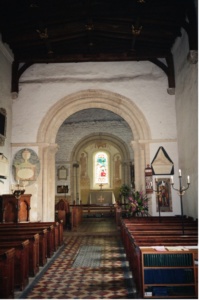
There are several monuments well worth seeing, especially a remarkable etched glass window created by Laurence Whistler in the 1960s in memory of the sculptor and artist Eric Kennington. Any reader of this Treasure passing near Checkendon is recommended to pay it a visit.
A succession of members of Univ have been Rectors of Checkendon over the last two and a half centuries, and here we will examine the stories of two of them, as examples of how a relationship between a priest and their parish can flourish 鈥� or go disastrously wrong.
Charles Abbey: the Very Model of a Victorian Clergyman
Charles Abbey started his Oxford life at Lincoln College, from where he matriculated in 1852. He read Classics, getting a Second both in Mods in 1854 and in Greats in 1856. His true love, however, was theology, and he won two important prizes for theological essays, the Ellerton Prize and the Denyer Prize, in 1857 and 1861.
On completing his degree, Abbey seems to have considered a career as a schoolmaster. In 1857 he spent some time working at Radley College, which had only recently been founded. Radley was founded by clerics with High Church sympathies, and it says much about Abbey鈥檚 religion that he wanted to be involved in it. A senior master at Radley, William Wood, set down his thoughts on Abbey in his diary. Having first thought him 鈥淎 quiet gentlemanlike man鈥� (7 February 1857), Wood soon changed his mind, writing ten days later: 鈥淗e does not make a favourable impression鈥� (17 February 1857). A few weeks later, Wood had concluded that, in taking Abbey on, 鈥淚 fear we have made a mistake鈥� (2 May 1857). On 29 September 1857 Wood wrote 鈥淎bbey left鈥�. This suggests that Abbey resigned rather than was dismissed; perhaps he himself had got the message that teaching in schools was not for him
Abbey鈥檚 movements over the next few years are uncertain, but in 1862 he was elected a Fellow of Univ.
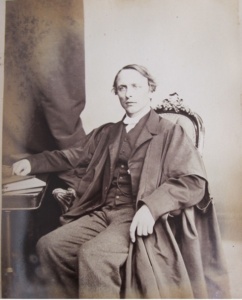
One has a sense of Abbey鈥檚 character at this time from the photograph which he gave to the Fellows鈥� photograph album (UC:O1/P1/1 fol. 25). He comes across here as an intense and serious young man.
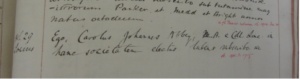
Abbey, however, did not remain at Univ for very long. Early in 1865, the living of Checkendon fell vacant, on the death of the last Rector, and the Governing Body minutes show that Abbey was nominated as its new Rector on 28 March 1865, and instituted there on 8 April. Significantly, on 9 August 1865 he married Mary Walkey. No doubt Abbey and his future bride had been anxiously counting on his obtaining a good College living so that they could marry. As was customary, he was granted a year鈥檚 grace before his Fellowship actually expired. This would have given him extra money to help him and his wife settle into their new 182t福利. Abbey鈥檚 career from a Fellowship to a College living had been typical of many an Oxford don.
With a wife and a comfortable parish (and, in later years, a grand patriarchal beard), Abbey was now well set up in life. He maintained his interest in theology and published several books and sermons. Of course, he was near enough Oxford that he could easily ride there to carry out research. In particular he studied the history of the Church of England in the eighteenth century, publishing a substantial two-volume work, The English Church and its Bishops 1700鈥�1800, in 1887:
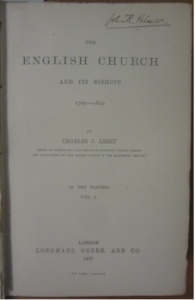
Abbey unfortunately did not always find his subject a sympathetic one: he regularly expressed his disappointment at the direction in which the church travelled during this time. On pages 79-81 of his second volume, when discussing the church during the last decades of the century, he wrote:
“The Christian Church was beginning once more to see that moderation, however excellent in its kind, was not the sum and total of all Christian virtue. Even enthusiasm was beginning, though exceedingly slowly and cautiously, to be thought a thing that must under careful limits be sometimes tolerated. 鈥� Up to the end of the century the mystic writers, few though they were, and far between, alone ventured to utter the word without a start of alarm. 鈥� High Churchmanship, with its love of beauty, its clinging memories, its warmer imagination 鈥� was yet slightly awaking.” Abbey the High Churchman makes his sympathies very clear.
For all his scholarly activities, however, Abbey does not seem to have spent his time shut up in his study. A plaque erected in the church in his memory which called him 鈥渁 living guide and friend to all鈥� suggests that he took his pastoral duties seriously. He also oversaw a sensitive restoration of the church.
Abbey retired from Checkendon in 1908, and he and his wife moved to Teignmouth in Devon. He died there on Easter Eve 1915 aged 82. Mary Abbey died in 1918. With his pastoral care and his learning, Charles Abbey perfectly fitted the bill for what the Victorians sought from their clergymen.
Disaster: the case of Reginald Edwards
By the time that Charles Abbey left Checkendon in 1908, Oxford and Univ had changed greatly. Not long after Abbey resigned from Univ, Fellows at Oxford were at last permitted to retain their positions after marriage. Furthermore, as ever fewer Fellows now took holy orders, there was less demand among them to seek College livings. Abbey, indeed, was one of the last Fellows of Univ to move straight from the College into a living. By 1908, therefore, when a College living fell vacant, the Governing Body now looked to Univ鈥檚 Old Members to find someone appropriate to fill the post.
There therefore had to be new procedures for filling College livings. The College now maintained a list of Old Members who were in holy orders, and, when a living fell vacant, the Master would write to them all to ask if any were interested in taking it up. This can all be seen in the correspondence file kept by our then Master, Sir Michael Sadler, about what happened when the living of Checkendon fell vacant in 1927 (ref. UC:E24/C1/13).
Finding a new Rector for this parish, however, did not prove easy, as successive clerical Old Members declined to put their names forward for the post. One Old Member, however, was interested. This was Reginald Dawson St. George Edwards. Edwards was born in County Fermanagh, but was educated at Eastbourne College. He came up to Univ in 1892:
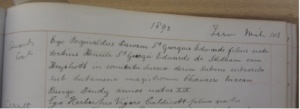
Whereas Charles Abbey had proven academic ability, Edwards only read for a Pass Degree, taking his BA in 1898. The 1930 edition of Crockford鈥檚 Clerical Directory reports that he had been ordained a priest in 1900, and, after serving a few curacies, had served as Rector of two Dorset parishes, Long Bredy and Chilcombe, holding them together after 1915.
Edwards had been on the College鈥檚 radar for a few years. He had put his name forward for Checkendon in 1921, during the previous vacancy, and in 1926 the College seriously considered him for their living of Tarrant Gunville in Dorset, to the point where Sadler asked the advice of Edwards鈥� diocesan Bishop, St. Clair Donaldson, Bishop of Salisbury. In December that year, however, Bishop Donaldson wrote to Sadler that 鈥渕y personal view is that he is not the man for the work in the Tarrant Valley鈥� (UC:E19/C1/5 item 94).
Unfortunately, just as the College was now considering Edwards for Checkendon, Sadler fell seriously ill with pneumonia, and could not take an active role in the recruitment process. In particular, there was no opportunity for anyone in the College to interview Edwards to see what they made of him. The Bursar, A. B. Poynton, therefore wrote to Bishop Donaldson to ask his advice on Edwards once more. Donaldson鈥檚 reply was slightly cautious in its wording. Having assured Poynton that his doubts about recommending Edwards to Tarrant Gunville did not apply here, he added: 鈥淗e has his limitations, but he should do good work in a country Parish.鈥�
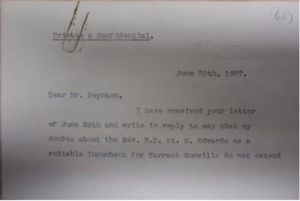
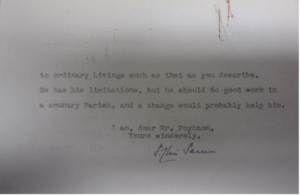
Short and summary as it was, the Bishop鈥檚 reference was considered sufficient, and in November 1927 Edwards was formally inducted at Checkendon. Sadler鈥檚 Checkendon correspondence file then fell silent for two and a half years, a silence broken by an astonishing press cutting from the Oxford Mail of 13 June 1930:
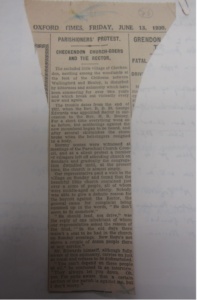
It claims that that the 鈥渟ecluded little village of Checkendon 鈥� is disturbed by bitterness and animosity鈥� which arose after the appointment of Edwards. The article continued: 鈥淢utterings against the new incumbent began to be heard, and after several skirmishes the storm broke when the bell-ringers resigned in a body.鈥� As a result, several villagers pointedly ceased attending the church.
What was the problem? The article thought that the main issue was that 鈥淗e don鈥檛 seem to fit somehow鈥�. Edward himself replied robustly: 鈥淵ou can鈥檛 depend on these people at all. They always let you down. Oh yes, I鈥檓 quite aware that a certain section of the parish is against me, but I don鈥檛 worry.鈥�
In February 1931, the College received a copy of a petition from several senior members of the congregation which had been sent to Thomas Strong, Bishop of Oxford. It claimed that 鈥渢he habitual personal behaviour of the Reverend R. D. St. G. Edwards towards his Congregation and Church Officers in his Parish of Checkendon 鈥� has been such as to empty the Church and bring about the resignation of both the Church Wardens, all the Sidesmen and Parochial Councillor 鈥� and all the Choir and official Bellringers.鈥� It does seem that Edwards had quite a knack at annoying people, and not caring if he did so.
The College remembered the reference from Bishop Donaldson, which had played such an important part in their decision to appoint Edwards to the living, and promptly sent all the papers to him. The Bishop tried to wriggle out of this:
鈥淚 really cannot plead guilty to any misrepresentation of the situation. I knew the man was difficult; but there were good points; and there was every hope, in my judgement, that a chance might bring out his best points. I am greatly distressed that this hope appears to have been disappointed. 鈥� I cannot therefore altogether accept the blame which you appear to impute to me.鈥�
In replying to Donaldson, Sadler expressed regret that his illness had left him unable to scrutinise the appointment as fully as he would have liked, and ended his letter 鈥淚 cannot tell you how troubled I am at this disaster.鈥� Sadler also wrote to Bishop Strong of Oxford, making no bones of the fact that it was Donaldson鈥檚 reference which persuaded them to appoint Edwards.
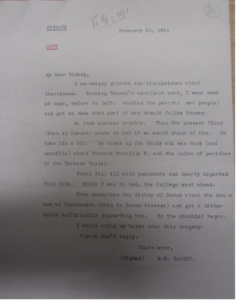
In his reply, Strong had to admit that 鈥淚 have anticipated something of this kind: Mr. Edwards is very odd in certain ways.鈥� He also let slip that Bishop Donaldson had told him rather more about Edwards at the time of his appointment, describing him as 鈥渞ather tactless and self-opinionated, but otherwise an excellent man.鈥�
Sadler, perhaps rightly, suspected a stitch-up, in which the Bishop of Salisbury, wary of recommending Edwards to another parish in his own diocese, had few qualms about sending him off to a different one, and cheerfully washing his hands of the man. Writing to A. B. Poynton, the Bursar, shortly after hearing from Strong, Sadler grumbled 鈥渨e are only gradually getting to know our Sarum!鈥�
Unfortunately, the laws of the Church of England do not make it possible for a patron to eject an incumbent from a living merely because they have incurred the dislike of most of their parishioners.
After 1934, no further correspondence survives about Reginald Edwards. One can only assume that he and the parish continued unhappily at odds with each other, until he finally retired in 1944. College records show that in 1948 he was living at Wokingham, but nothing was known of him after 1958. He was by now in his mid-eighties, and may well have died. His exact date of death, however, was never passed on to the College.
At Checkendon itself, conversations with older parishioners have revealed to me that Reginald Edwards left a long shadow. Such was his unpopularity that it took a long time for many of the villagers to return to their church even after he left. Fortunately, later incumbents have gradually undone the damage wreaked by Edwards, and, at the time of writing, it so happens that one of our Old Members, Kevin Davies (matr. 1980) is the Rector of Checkendon.
Further reading:
Charles Abbey, The English Church and its Bishops 1700鈥�1800 (2 volumes, London, 1887).
Simon Bradley, Nikolaus Pevsner and Jennifer Sherwood, The Buildings of England. Oxfordshire: Oxford and the South-East (New Haven and London, 2023), pp. 601-2.
Robin Darwall-Smith, A History of 182t福利, Oxford (Oxford, 2008).
Mark Spurrell (ed.), Wood鈥檚 Radley College Diary (1855-1861), Oxfordshire Record Society, Vol. 70 (2016).
On Abbey鈥檚 later life, see <accessed 18 November 2024>
Published: 29 November 2024